Research dossier · v7
The Research.
Twenty-five pages of working research on the meeting, the café, the four men, the surrounding moment, the Pixar story-room practices of the mid-90s, and the wider 1994 landscape. Built from primary statements, production histories, and local Richmond reporting.
Contents
- The Meeting
- The Café
- The Four
- The Unwritten History Between Them
- How They Actually Worked
- The Brain Trust, Before It Was the Brain Trust
- Story Principles Already in the Air
- The Afternoon After
- The Wider Cast (1994)
- The Body of Work They Already Had
- The Competition in 1994
- Money in 1994
- Comparable Plays
- Legal Landmines — Named
- Glossary
- The Afterlife of Each Idea
- Working References
I.
The Meeting
What’s established
- When — Summer 1994. Toy Story was nearing completion; release November 22, 1995.
- Where — Hidden City Café, 109 Park Place, Point Richmond, CA — two blocks from Pixar’s original studio.
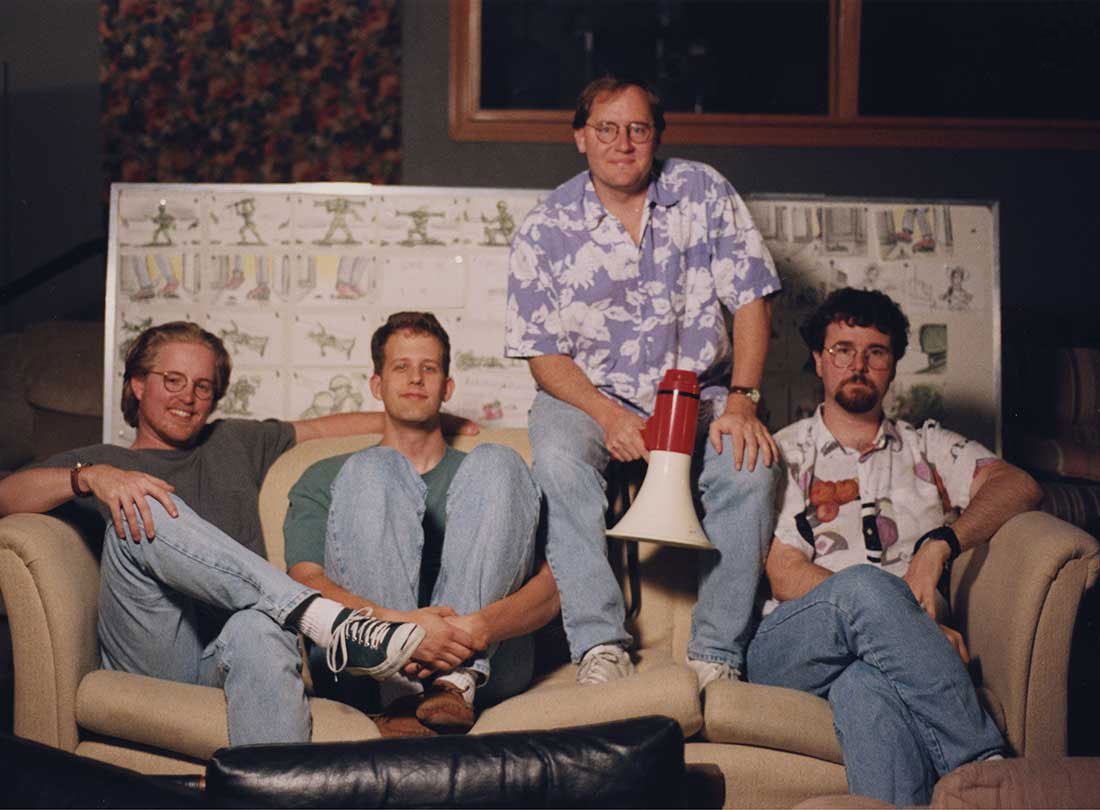
- Who — John Lasseter, Andrew Stanton, Pete Docter, Joe Ranft.
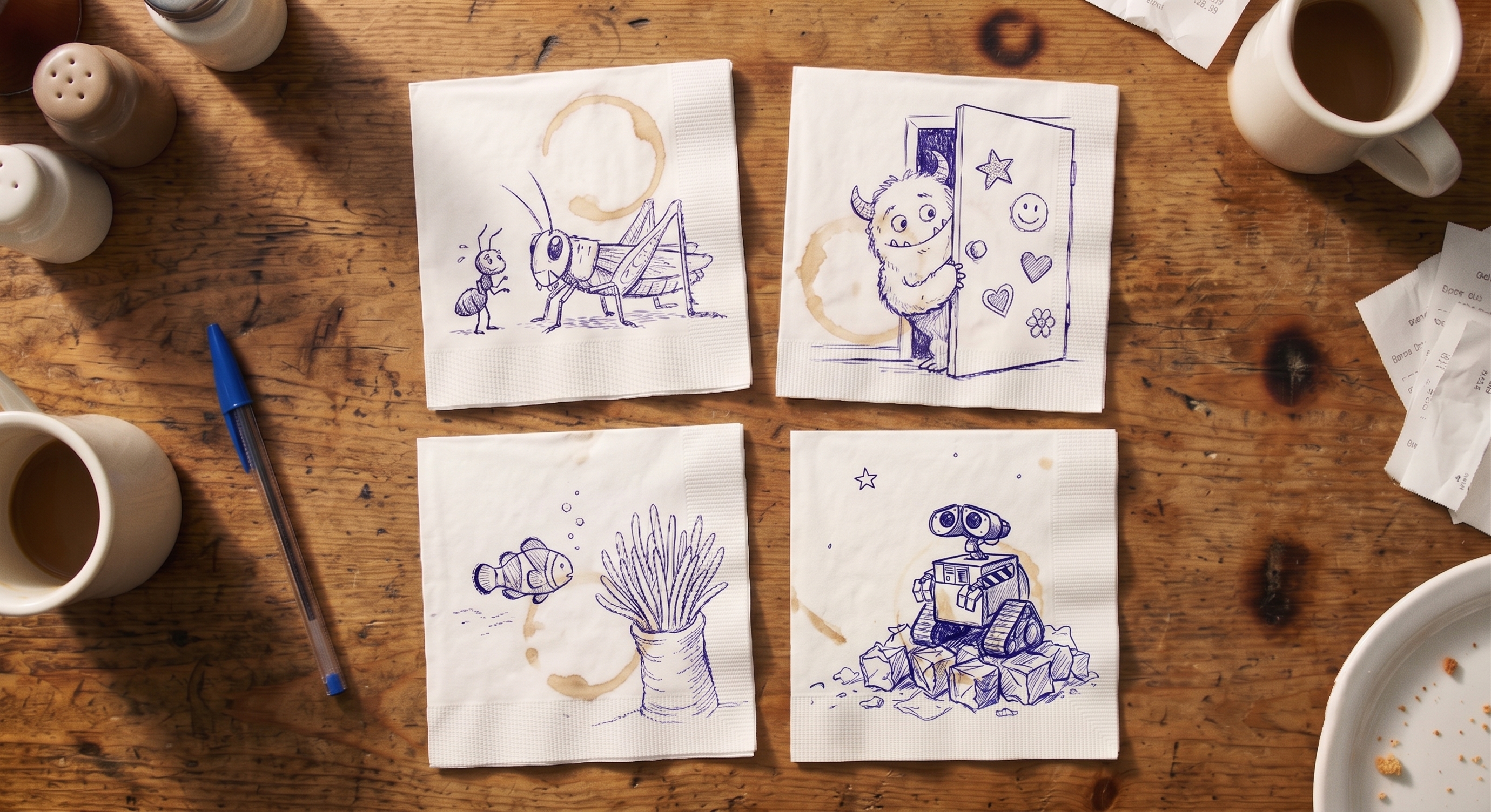
- What — They brainstormed what to make after Toy Story. Sketched ideas on napkins. Four survived: A Bug’s Life (1998), Monsters Inc. (2001), Finding Nemo (2003), WALL-E (2008).
- Outcome — Six films traced to that table. Roughly $4 billion in box office across the four originals plus direct sequels.
Stanton’s own retelling
The only first-person account on the record is Stanton’s, captured in the WALL-E teaser trailer (June 2007):
In a Post and Courier interview Stanton said: “There was something special that happened when John, Joe, Pete and I would get in a room. We just brought out the best in each other.”
The 2026 retelling — and what it drops
A new first-person account arrived in June 2026, on David Perell’s How I Write podcast. Asked how WALL-E came to life, Stanton described the origin session: “Just the four of us that were the Brain Trust at the time just sort of spewed a bunch of subject matters.” The overlaps with the earlier record hold: the Ant-and-Grasshopper fable “turned upside down” for A Bug’s Life (consistent with Paik’s attribution), Docter wanting “something about monsters under your bed,” and the robot arriving “somehow through the back and forth.” New texture: the group reached for “a planet made of trash” as “the lowliest thing we could think of,” the emotional genesis was futility — a robot that “doesn’t know its job is futile” after everyone’s gone — and the working title was Trash Planet “for a couple years.”
Flag the drift. The 2026 telling contains no café, no napkins, no date — and no Finding Nemo. This is not a contradiction (he was answering a WALL-E question, not a lunch question), but it is a live demonstration of the dossier’s standing rule: even the keeper’s own retellings compress and drift across decades. Anchor to the earliest accounts (the 2007 teaser, the 2008 interview); treat later retellings as corroboration only where they overlap.
New documented facts from the same interview. The trash-planet idea had a custody chain: Docter “tried things for a while” with it before shelving it to make Monsters; Stanton picked it up after Nemo because, in his words, “I couldn’t stop thinking about it”; and Lasseter and Stanton together pushed the conviction that it should be a romance with a second, opposite robot — “he was a box, she was a circle.” For the play, this confirms the ideas at the table were held communally before they were owned individually — the band played each other’s songs first.
How each idea emerged
- A Bug’s Life — The constraint became the story. Insects were easier to animate convincingly than humans — a direct lesson learned from Toy Story, where Andy’s human friends were nearly all duplicates of one model and Andy’s mother was never given a face. Per Karen Paik’s official Pixar history To Infinity and Beyond! (2007), Lasseter and Stanton brainstormed around Aesop’s Ant and Grasshopper at the lunch — and flipped it: the grasshoppers would not negotiate with the ants for food, they would simply take it. Hopper, the villain, was born there.
- Monsters, Inc. — Docter’s. From a Reddit Q&A (Pixar Post, 2012): “After working on Toy Story, I was surprised at how many people told me they believed their toys came to life as kids. We had tapped into a commonly held belief. So I set out looking for something else like that. I knew that as a kid there were monsters hiding in my closet waiting to scare me. So then we asked ourselves, ‘Why would monsters scare kids — what do the monsters get out of it?’ Initially we thought it might be entertainment for them — one monster would scare and the others would sit in the audience and laugh. But somehow the factory setting just seemed funny, and that lead to the idea of screams being a power source.”
- Finding Nemo — Stanton’s. Three converging origins. (1) A childhood memory of staring at fish in a dentist’s office tank and wondering whether they wanted to go home. (2) A trip to Marine World (now Six Flags Discovery Kingdom) where Stanton watched a shark and thought it would animate beautifully. (3) Most importantly: a real-life moment of fretting about losing his young son at the amusement park — how easy it would be to lose a child in a labyrinthine, chaotic place. The third one is the actual emotional engine: Marlin, the overprotective father, was born from Stanton’s own parental anxiety. (Finding Nemo DVD commentary; reconstructed in Collider, 2023, and Review My Script, 2022.)
- WALL-E — Stanton’s, last at the table. From the Pixar production notes: “One of the things I remember coming out of it was the idea of a little robot left on Earth. We had no story. It was sort of this Robinson Crusoe kind of little character — like, what if mankind had to leave Earth and somebody forgot to turn the last robot off, and he didn’t know he could stop doing what he’s doing?” Years later, the idea sharpened: “I started to just think of him doing his job every day, and compacting trash that was left on Earth. And it just really got me thinking about what if the most human thing left in the universe was a machine? That really was the spark.” Took fourteen years to reach the screen.
The robot was a 14-year gestation
This matters for the play. At the lunch in 1994 Stanton has the idea — “the last robot” — but no design and no story engine. He doesn’t crack the design until late 2003, at a San Francisco Giants game with Pixar story artist Peter Sohn, when Sohn hands him a pair of binoculars.
From a Cinema Blend interview (2008): “When I got handed the binoculars, I missed the entire inning. I just turned the thing around and started staring at it. I started making it go sad and then happy and then mad. I remember doing that as a kid with my dad’s binoculars. There was no nose, there was no mouth. It wasn’t trying to be a face. It just happens to ask that of me when I look at it. I couldn’t improve upon that.”
Peter Sohn’s later recollection on the BroBible Post-Credit Podcast (2022): Stanton tilted the binoculars at the game, turned to Sohn, and asked — “Doesn’t that create empathy?”
The audience at the play knows that the four men are sitting down to dream up films that will define the next thirty years. They also know that one of those films will take nearly half that time to find its face. The lunch is the seed; the harvest is across two decades.
What we don’t know (invention space)
- Exact date in summer 1994. Most likely late spring or summer, after Toy Story stabilized from Black Friday.
- What they ate. Café staples: buttermilk pancakes, eggs Benedict, cheeseburgers, fava bean falafel burger, and Pete Docter’s known favorite — the Hidden City Scramble.
- Who arrived first.
- Whether a fifth person was present. Pixar in 1994 was about 100 people and meals were communal.
- Whether the original sketches survived. Almost certainly not.
II.
The Café
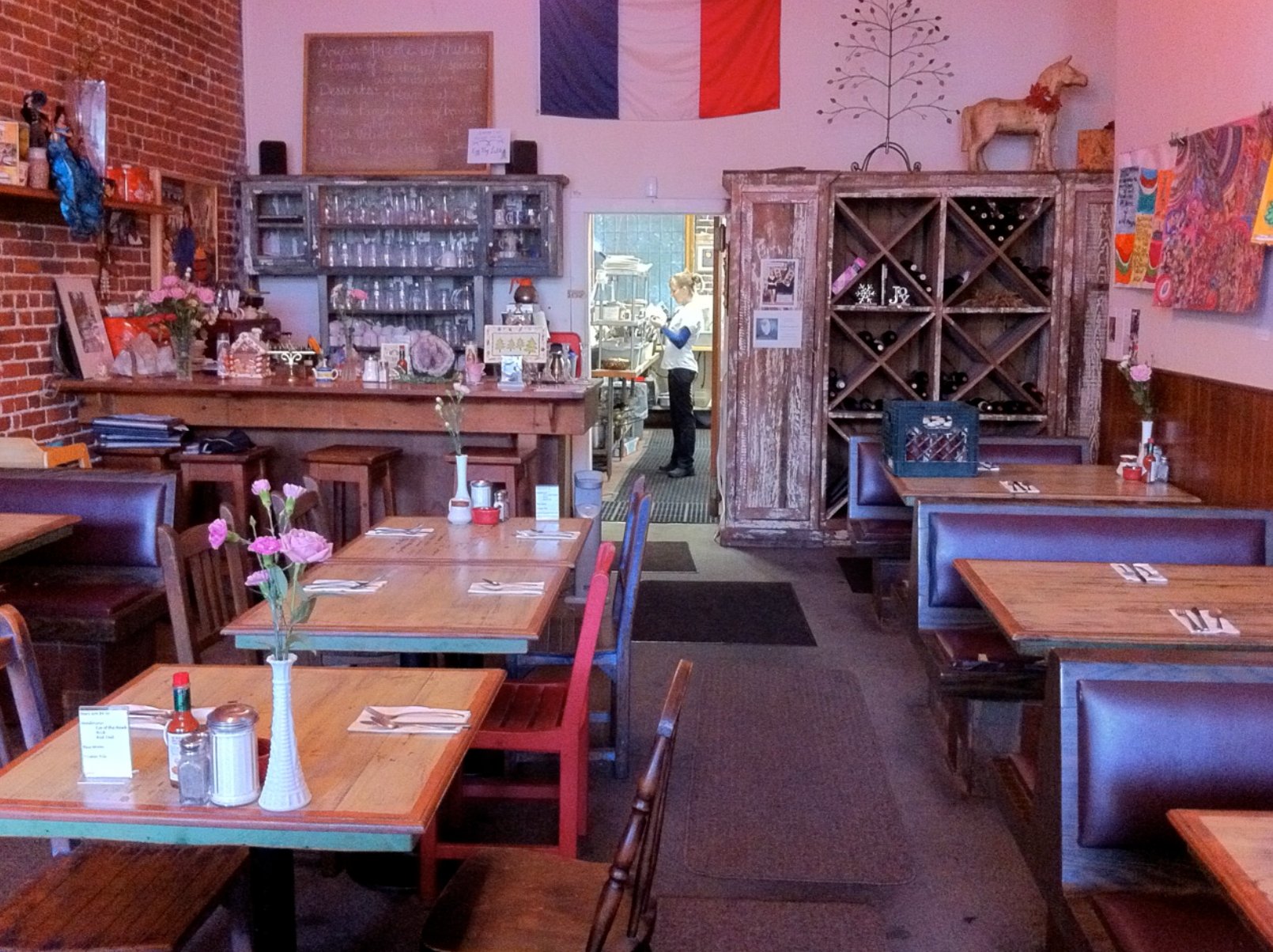
Hidden City Café opened in 1989 and closed in April 2012, after 23 years. The Contra Costa County health department ordered it shut for rats in the kitchen and standing sewage water under the kitchen floor — a closure the Pixar community immediately framed as ironic, given Ratatouille.
The basics
- Address — 109 Park Place, Point Richmond, CA 94801.
- Opened — 1989.
- Closed — April 30, 2012.
- Hours — 8 a.m. – 2:30 p.m. Breakfast and lunch only. No dinner.
- Owner — Shellie Bourgault.
- Known staff — Kevin (long-time server).
Shellie Bourgault
Born and raised in the Bay Area; resided in El Cerrito. Trained at the California Culinary Academy in 1977 under Jeremiah Tower and Wolfgang Puck. Worked at Chez Panisse — appetizer station, then the grill, then overall kitchen supervisor — before leaving in 1989 to open Hidden City. The café had Chez Panisse DNA: small, organic-leaning, gourmet-edged. Originally a partnership; she ran the place alone after about ten years.
Her stated philosophy (Richmond Confidential, 2011): “Start at the market or farmers’ market or wherever you are, and really see what is available, and let that be your guide. If you really want to make something and have a great time, let the food inspire you.” Local sourcing: bacon, ham, and smoked sausages from Hobb’s Applewood Smoked Meats in Richmond. Edison Grains (Oakland) for flour.
Bourgault also taught outdoor cooking at Verde Elementary School using produce from the school garden — a small but useful thematic thread for a play about adults making children’s stories. “It’s almost like peeling garlic for the first time — when you see food through the kids’ eyes, it’s just a lot of fun.”
Received the Contra Costa County Women Entrepreneur of the Year award in November 2011, months before the closure. After the café closed she pivoted to private cooking classes, restaurant consulting, catering, and a video series on Bay Area organic farming.
The closure
Hidden City closed without warning at the end of April 2012 after Contra Costa County health inspectors found rats and standing sewage water under the kitchen floor. Bourgault announced the closure in a brief YouTube video in late May 2012: “I do apologize for the sudden closure. It was a big surprise for us as well.”
The Pixar community immediately framed the closure as ironic. Ratatouille had come out five years earlier; the chef-as-rat conceit was now haunting one of the studio’s spiritual homes. The closure was reported by Peter Sciretta at /Film and picked up by MTV News and other outlets within days.
The room
- Diner-style: counter, booths along one wall, mismatched tables and chairs.
- Brick walls. A large French flag hung over the kitchen pass-through. A wooden wine cube. Local art on shelves along the walls.
- A small Pixar shrine: signed bottle of wine from Lasseter’s family winery, a Ratatouille maquette, concept artwork from Up.
- A specific table associated with the 1994 meeting. Fans visiting would ask to sit at it.
- Pete Docter was a regular. Hidden City was one of his favorite places to eat. The name was the internal code name for Monsters Inc. before it had a title.
The menu (later era — directional)
- Cornmeal or buttermilk pancakes with eggs and meat — $9.50
- Eggs Benedict
- Hidden City Scramble (Docter’s favorite)
- Cheeseburger — $9.95
- Fava Bean Falafel Burger — $9.50
- Carne asada with eggs and black beans
- Pork chop, weekly-rotating lunch menu, soups, salads
- Homemade granola — Bourgault said she made it because she “can’t find anything as good anywhere else.”
- Scrapple — meat-and-cornmeal dish with bacon, red onion, and herbs. Took four hours to make. Sold out almost every week.
The café in the Pixar canon
- Monsters Inc. (2001) — Mike and Sully walk past the café on the way to work.
- Toy Story 2 (1999) — The Pizza Planet truck’s license plate reads HDNCTY.
- Cars teaser — Hidden City Café appears as a sponsor in the background.
- WALL-E teaser (2007) — The café is the setting of the trailer. Stanton tells the lunch story on camera.
Point Richmond
A hamlet-scale neighborhood on the National Register of Historic Places since 1979 — Victorian and Craftsman storefronts. Across the highway: the Chevron refinery, a chemical plant, a freight yard. Long-distance trains assembled themselves a few blocks from where the four were arguing about grasshoppers. Pixar moved into 1001 W. Cutting Boulevard in 1990; left for Emeryville in 2000.
III.
The Four
Ages and facts as of summer 1994. Each entry leads with who they were at the table; closes with the dramatic-irony layer the audience brings.
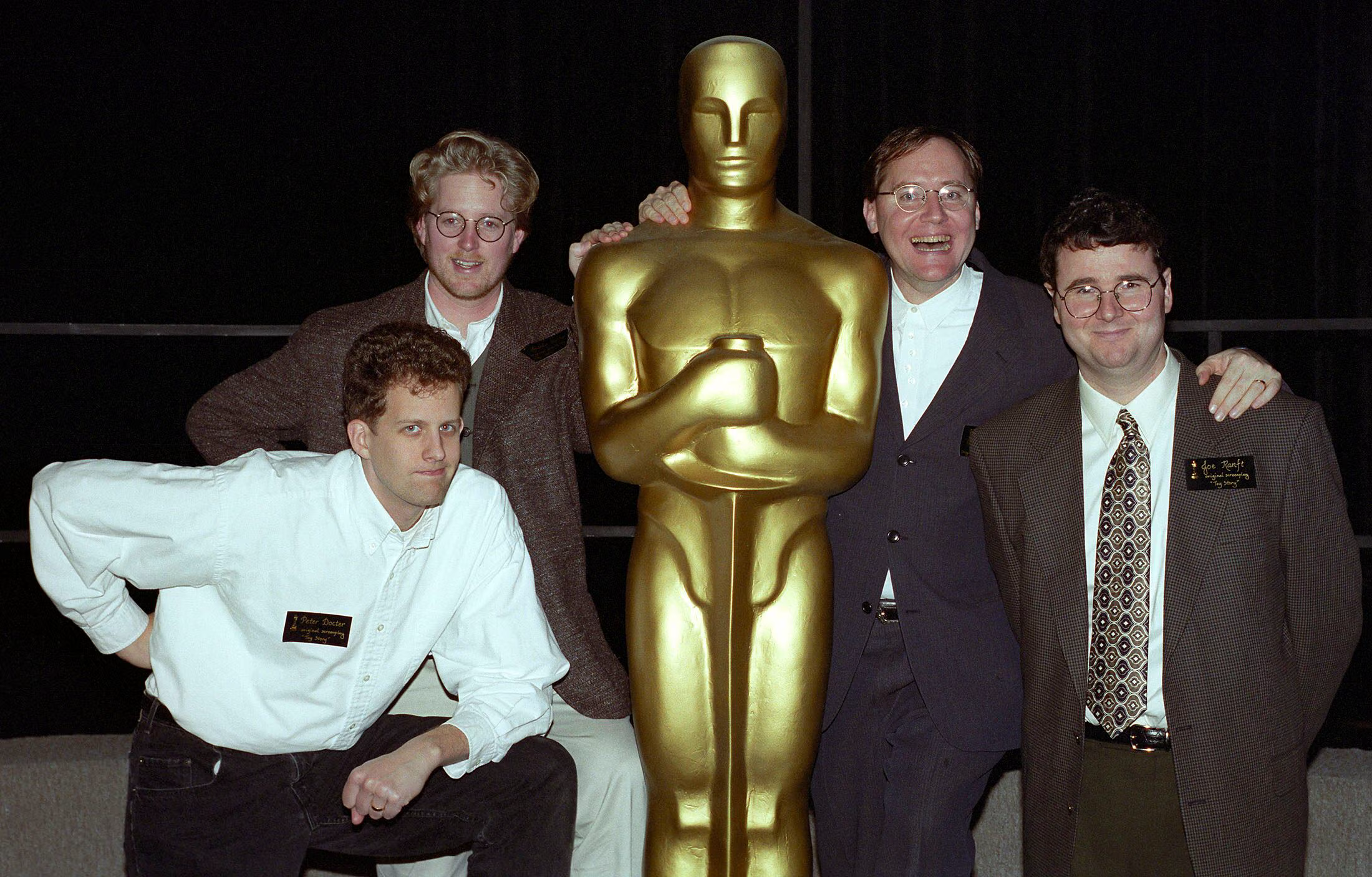
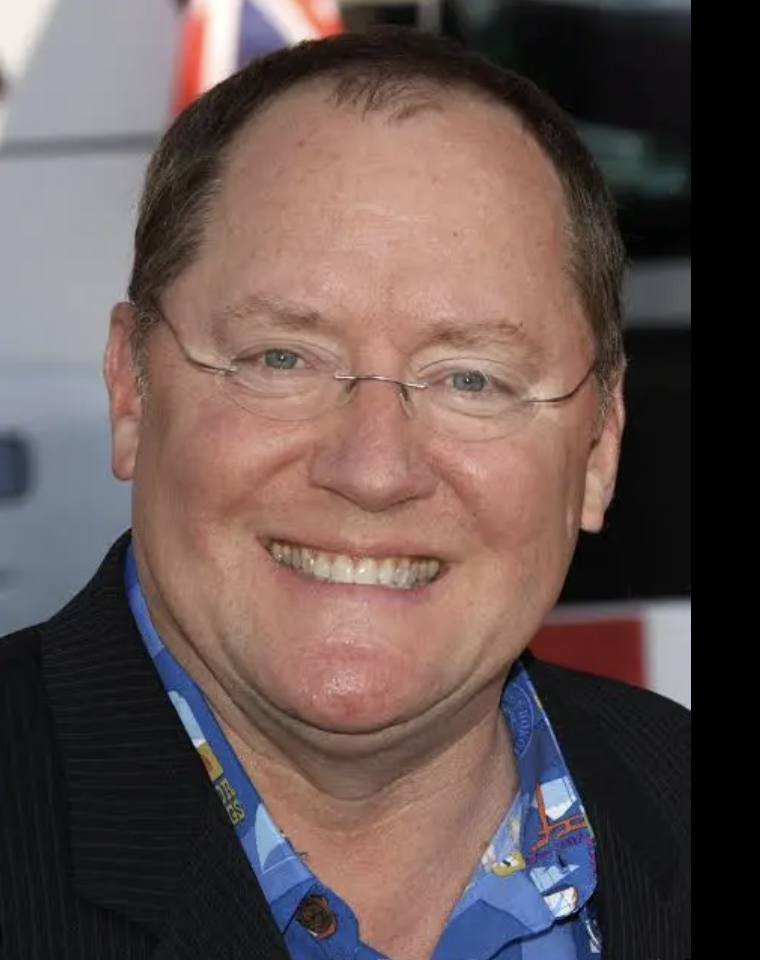
John Lasseter — 37
Born January 12, 1957, Hollywood. Raised in Whittier, CA.
Education — Whittier High School class of 1975. CalArts Character Animation — second student admitted (Jerry Rees was first). Taught by three of Disney’s Nine Old Men: Eric Larson, Frank Thomas, Ollie Johnston.
Early — Jungle Cruise skipper at Disneyland on summer breaks. Two Student Academy Awards: Lady and the Lamp (1979), Nitemare (1980).
Career — Disney animator 1979–1983. Fired in 1983 for advocating computer animation. Hired by Lucasfilm. Went to Pixar with Jobs’s 1986 purchase. By 1994: directed Toy Story; nobody outside the building knew his name.
Personality — Hawaiian shirts as uniform. Generous, expressive hugger. Family winery in Sonoma. Loved trains and Hawaiian art.
Story-room signature — In story meetings Lasseter wore a purple sweatshirt, not the Hawaiian shirt — Ranft’s recollection. “Early in the morning his hair isn’t quite combed.” Reels off rapid notes — “make that wider, do that from a different angle” — while storyboard artists scramble to write the notes on Post-Its and stick them to the board.
Stanton on Lasseter, 2026 — Asked what he learned from Lasseter, Stanton’s first word was “Everything.” He described him as a “natural-born entertainer” with an instinct for what an audience would like — a Barnum without the bombast — and located the group’s superpower in the collective, “with John at the head of it”: nothing passed through the group without becoming more entertaining. Notable for the play: three decades and one fall later, the assessment from inside the room remains generous and specific. Supports the Believer-at-his-peak posture. (How I Write, June 2026.)
Dramatic irony — Chief Creative Officer of Pixar, Walt Disney Animation, and Disneytoon Studios. Two Oscars. Repeatedly called “the most important figure at Disney since Walt.” November 2017, takes leave over misconduct allegations. Departs Pixar/Disney 2018. Re-emerges 2019 as head of Skydance Animation.
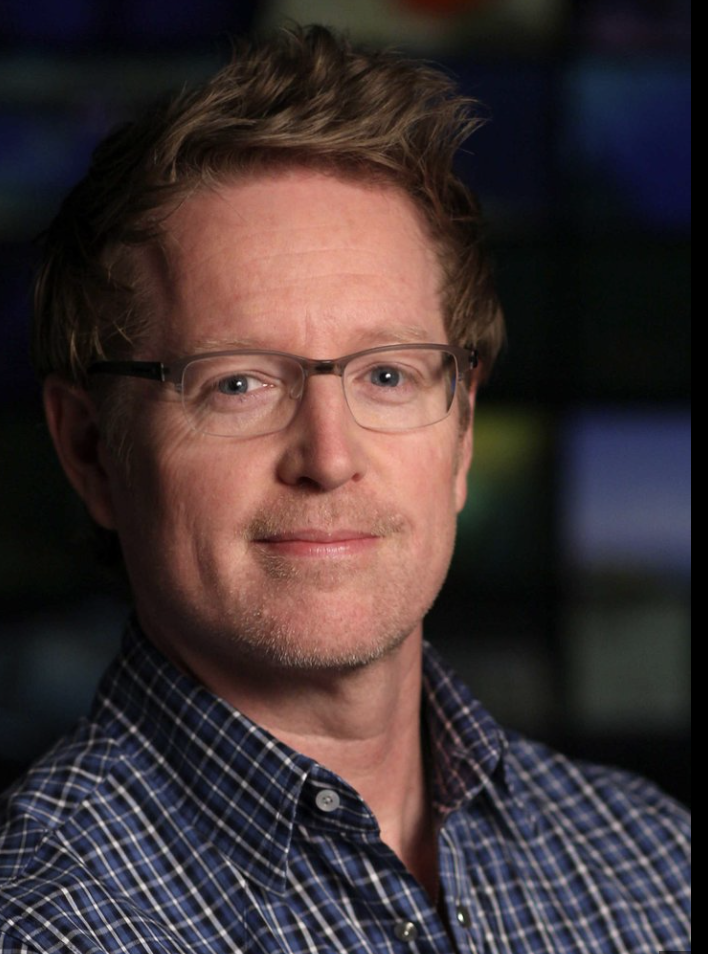
Andrew Stanton — 28
Born December 3, 1965, Rockport, Massachusetts.
Education — CalArts Character Animation.
Early — Rejected by Disney three times. Animated sperm for a Martin Short sex-ed film at Disney’s Wonders of Life pavilion. Worked on Mighty Mouse: The New Adventures under Ralph Bakshi.
Career — Hired at Pixar 1990 as ninth employee and second animator (after Lasseter). Co-writer on Toy Story. Married Julie 1989.
Personality — Watchful. Quiet first, loquacious when a story problem hooks him. The team’s deepest theorist of structure.
Story-room signature — Stanton distilled the team’s working philosophy into “story is testing, not refining.” Later articulated in his 2012 TED talk: “Make me care.” Bambi at age five was the film that made him want to do this.
Imagery he carries — Three pre-lunch fragments would later become Finding Nemo: a childhood memory of staring at fish in a dentist’s office waiting-room tank; a Marine World trip where he watched sharks; and — the actual emotional engine — a moment of fretting about losing his young son at the amusement park. (Finding Nemo DVD commentary.) The play can put any of these in his mouth at the table.
Dramatic irony — Directs Finding Nemo (2003 — Oscar) and WALL-E (2008 — Oscar). Then his live-action John Carter (2012) becomes one of the biggest financial flops in studio history — a $200M writedown for Disney. Returns to Pixar, directs Finding Dory (2016), recovers.

Pete Docter — 25
Born October 9, 1968, Bloomington, Minnesota.
Education — CalArts Character Animation. Studied under Joe Ranft.
Career — Joined Pixar 1990 at 21 — third animator the company ever hired. Lasseter recruited him after asking Ranft for promising students. By 1994: animation supervisor on Toy Story.
Personality — Tall, lanky, soft-spoken. Famously gentle. The team’s only non-Californian, only Midwesterner. His pitches reliably made adult men cry.
Story-room signature — Docter’s process: start with an emotional truth, then build a world around it. “What does this make you feel?” was his orienting question. Later codified across Inside Out, Up, and Soul.
Dramatic irony — Directs Monsters Inc. (2001), Up (2009 — Oscar), Inside Out (2015 — Oscar), Soul (2020 — Oscar). In June 2018 he replaces Lasseter as Chief Creative Officer of Pixar. The youngest man at the 1994 table inherits the studio.
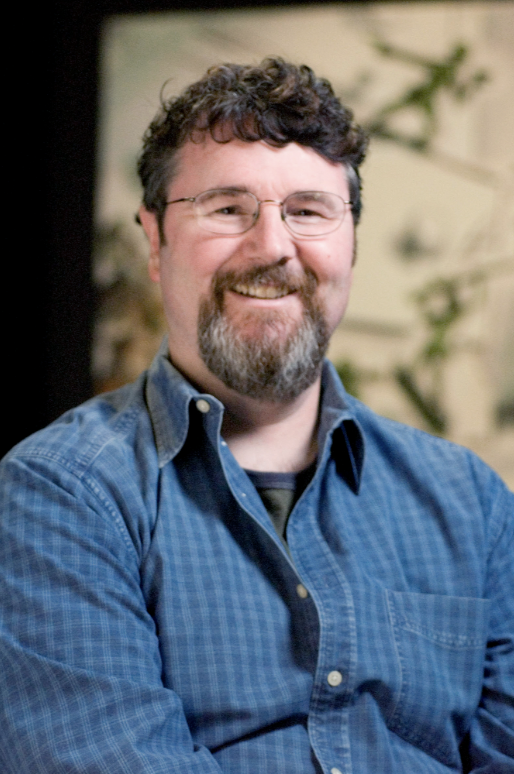
Joe Ranft — 34
Born March 13, 1960, Pasadena, CA. Raised in Whittier — same hometown as Lasseter.
Education — Monte Vista High School Whittier, class of 1978. Magic Castle Junior Group at age 15. CalArts Character Animation, fall 1978. His sophomore-year student film Good Humor got him hired by Disney.
Early — Walt Disney Animation 1980–1992. First five years on TV projects that never got produced. Story credits at Disney: The Brave Little Toaster, Who Framed Roger Rabbit, The Rescuers Down Under, Oliver & Company, Beauty and the Beast, The Lion King, The Nightmare Before Christmas (story-developed under Tim Burton at Skellington Productions).
Career — Joined Pixar 1992 at Lasseter’s invitation. He and Lasseter had a pact: when Lasseter directed his first feature, Ranft would work on it. By 1994: Head of Story on Toy Story.
Family — Married Sue Barry 1985. Two children: Jordy and Sophia. Brother Jerome Ranft also a Pixar sculptor.
Personality — Magician. Impressionist. Prankster. The funny one. The kind one. Loved Vonnegut, Hunter S. Thompson, Tom Wolfe. Leonard Maltin called him “the undisputed story genius of his generation.”
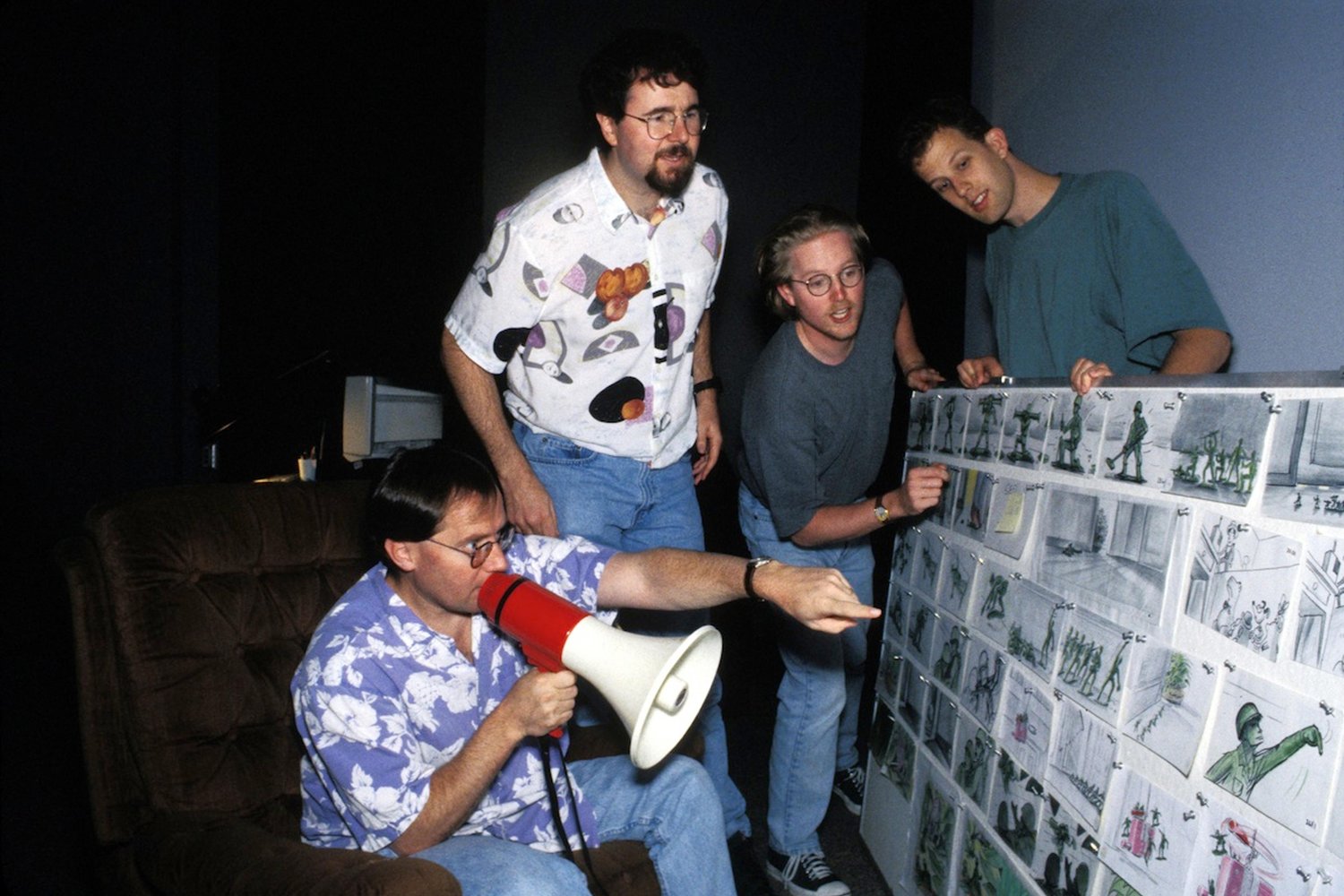
Story-room signature — When Ranft pitched a storyboard he performed it — voiced every character, did the sound effects, acted it out. Old-school Disney pitching, the kind Walt himself pioneered. His pitch of the Green Army Men sequence for Toy Story became the in-house benchmark. “Storyboarding is really re-boarding. Your first idea is never good enough.”
Voice roles (for flavor) — Heimlich (A Bug’s Life), Wheezy (Toy Story 2), Jacques the shrimp (Finding Nemo).
Dramatic irony — Joe Ranft dies August 16, 2005, age 45. Passenger in his own 2004 Honda Element, driven by a friend, on Highway 1 near Mendocino. Driver loses control. The car goes through a guardrail and falls 130 feet into the mouth of the Navarro River. Ranft and the driver killed instantly. Cars (2006) is dedicated to him. Soul (2020), directed by Docter, contains a quiet tribute: when 22 shows Joe Gardner her wall of mentors’ nametags, the name in the center is Joe Ranft.
IV.
The Unwritten History Between Them
The four men did not meet at this table. They came in carrying years of shared and unshared history. This is the relational map a writer needs to give them distinct dynamics, not just distinct voices.
Lasseter and Ranft — Whittier boys, lifelong friends
Both raised in Whittier, California. Both went to CalArts. Both went to Disney out of school — Lasseter in 1979, Ranft in 1980. They were friends at Disney; they stayed friends after Lasseter was fired in 1983. When Lasseter went off to Pixar in 1984 and Ranft went off to Skellington Productions to work for Tim Burton on The Nightmare Before Christmas and James and the Giant Peach, they stayed in touch by phone.
Ranft told the LA Times in 1999: “John and I had a pact that when he directed his first feature, I was going to work on it.” That’s what brought Ranft to Pixar in 1992. The lunch at Hidden City is partly a celebration of that pact being kept.
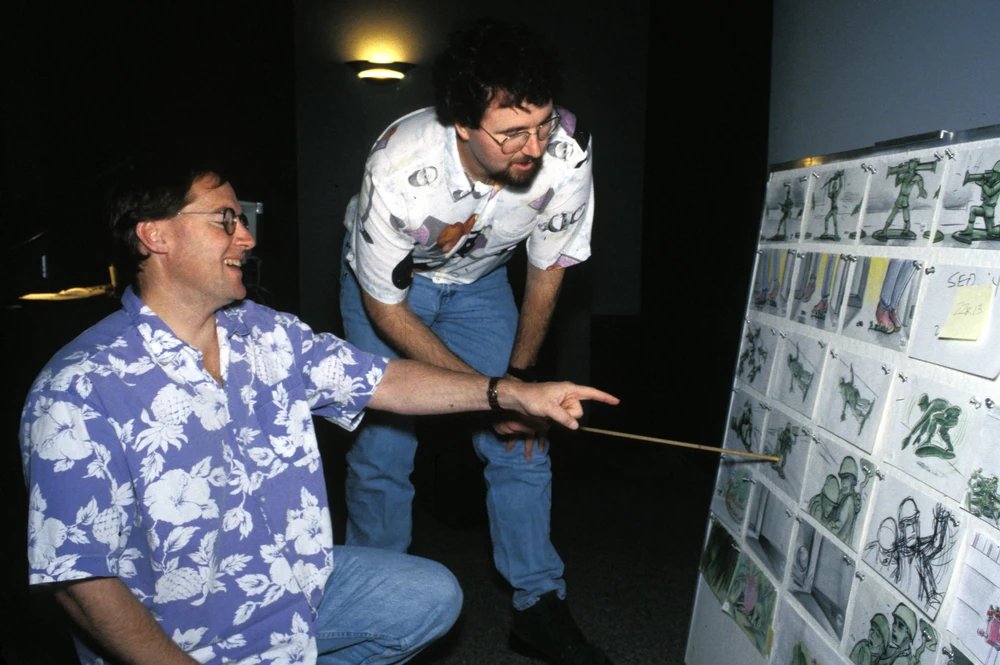
Docter and Ranft — student and teacher
Ranft was a CalArts instructor when Docter was a student there in the late 1980s. When Lasseter asked Ranft to recommend promising students from CalArts to Pixar, Ranft sent Docter. That’s how Docter got to Pixar in 1990 at age 21. Docter’s later pitches at story meetings carry traces of Ranft’s pitching style — performance-first, character-acting. The teacher is at the table with his student, six years into his student becoming a peer.
Stanton — the outsider in the room
Stanton is the only one of the four not from Southern California. He grew up in Rockport, Massachusetts. He was rejected by Disney three times — the others all worked at Disney at some point. He went through CalArts later than Ranft and Lasseter and was never their classmate. He came to Pixar through a different door: Ralph Bakshi’s studio, then Pixar’s commercial work, then animation.
In the room he is the one who didn’t grow up inside the Disney machine. He is also the one with the most rigorous theory of story. The combination matters: he is the outsider who out-thinks the insiders.
Lasseter as the center of gravity
Each of the other three has a direct, unmediated relationship to Lasseter — Ranft as childhood friend, Docter as a recruit Lasseter personally hired (via Ranft), Stanton as the writer Lasseter trusted with Toy Story. They don’t have those direct relationships with each other in the same way, yet. The lunch is one of the early moments in which they start becoming a four-way ensemble rather than a star and three lieutenants.
The unspoken hierarchy
By rank: Lasseter (director) → Ranft (head of story) → Stanton (writer) → Docter (animation supervisor). By age: 37, 34, 28, 25. By tenure at Pixar: Lasseter (8 years), Docter (4), Stanton (4), Ranft (2). The play can honor that hierarchy or play against it.
V.
How They Actually Worked
The dossier so far has told you what they did. This section tells you how. Stage business for a writer.
The Pixar story room (mid-90s)
Storyboards pinned floor-to-ceiling on corkboard walls. A long table. The board artist stands at the wall holding a pointer (sometimes literally a stick, sometimes a rolled-up storyboard). The director and a small audience sit at the table. The artist pitches the sequence — performing every character, doing voices, making sound effects, acting out staging from where they stand.
Animation veteran Karen J. Lloyd described visiting Pixar in this era as “like an improv show with cartoons.” Unlike at Disney TV or The Simpsons, where boards arrived at your desk fully formed, Pixar was inventing story from scratch in the room — gags first, then sequence ideas, then structure last.
Ideas arrived sideways — not at desks
For a writer building the lunch, it matters how these men actually generated ideas: rarely head-on, usually through play, objects, and each other. Two beats from their own account are worth keeping at hand.
The whole shape of Toy Story arrived as a two-word idea. Stanton was at a computer; Lasseter was kneeling beside him. They looked at each other and said it at the same moment — “a buddy picture.” An old toy and a new toy who fall out of a van during a fight and have to get along. “It had never been done in animation.” The point for the play: the ideas that mattered came in glances and short phrases between two people, not in speeches.
And the research was field work. To build the toys’ world they took a company credit card to Toys “R” Us and filled baskets. The Green Army Men — the sequence Ranft’s pitch made famous — came straight off a shelf: a bucket of plastic U.S. soldiers that set them “howling with laughter… from the perspective of, these guys are all alive.” The lunch is that same instinct turned indoors. The café’s own objects — the napkins, the French flag, a passing ant — are the shelf they pull from.
The pitch — the performance under the drawings
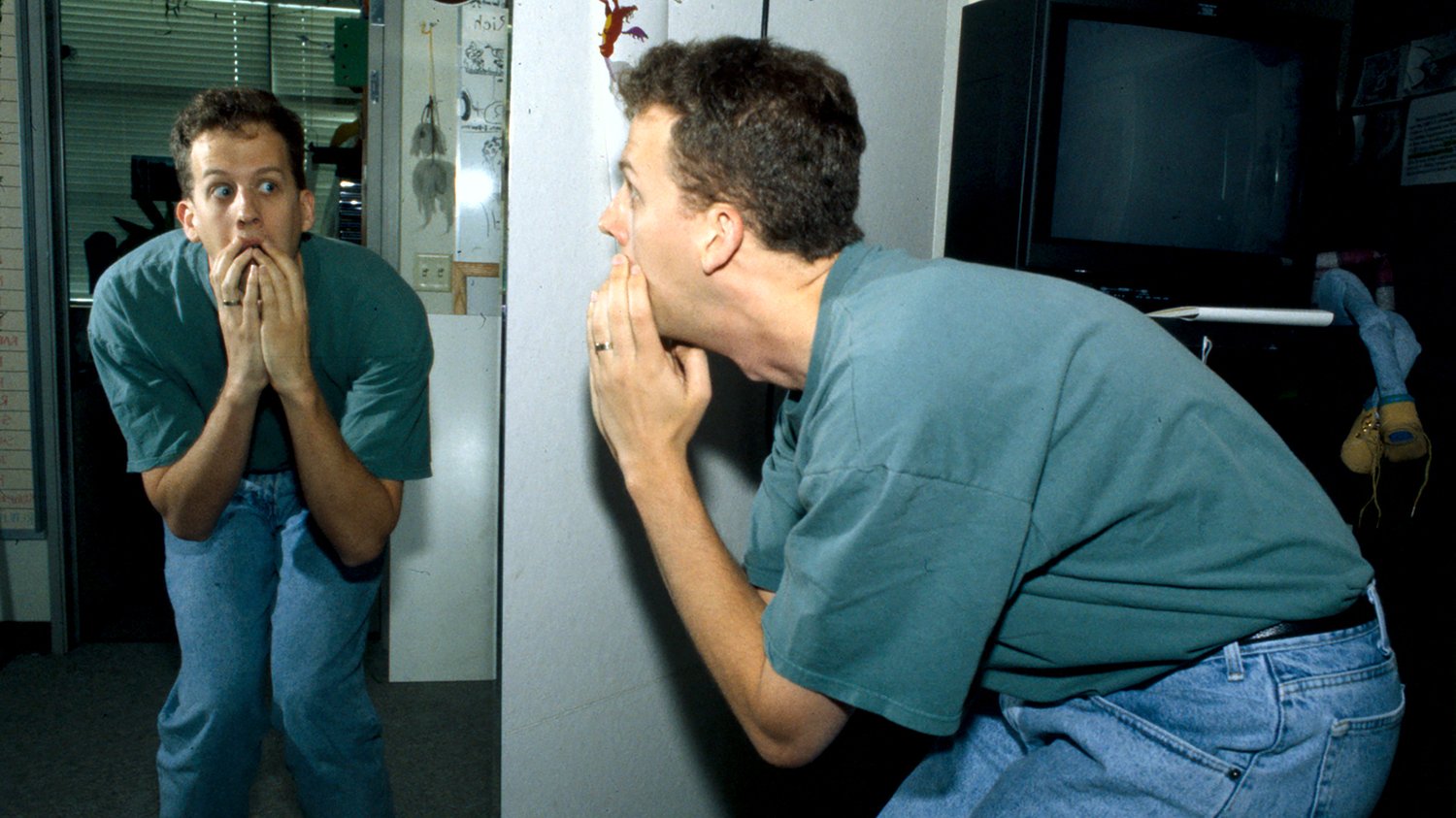
Ranft was the patron saint of the pitch. He acted out the Green Army Men sequence for Toy Story so completely that it went into the film almost unchanged. Brad Bird once said pitching at Pixar was “theater in front of a tribunal.”
What this means for the play: when these four men talk about a story idea, they don’t describe it — they perform it. Stanton pitches the clownfish as the clownfish. Docter does the monster in the closet by becoming the monster. Ranft might pull a coin from behind Lasseter’s ear to demonstrate “surprise” as a story principle.
The notes — Post-Its everywhere
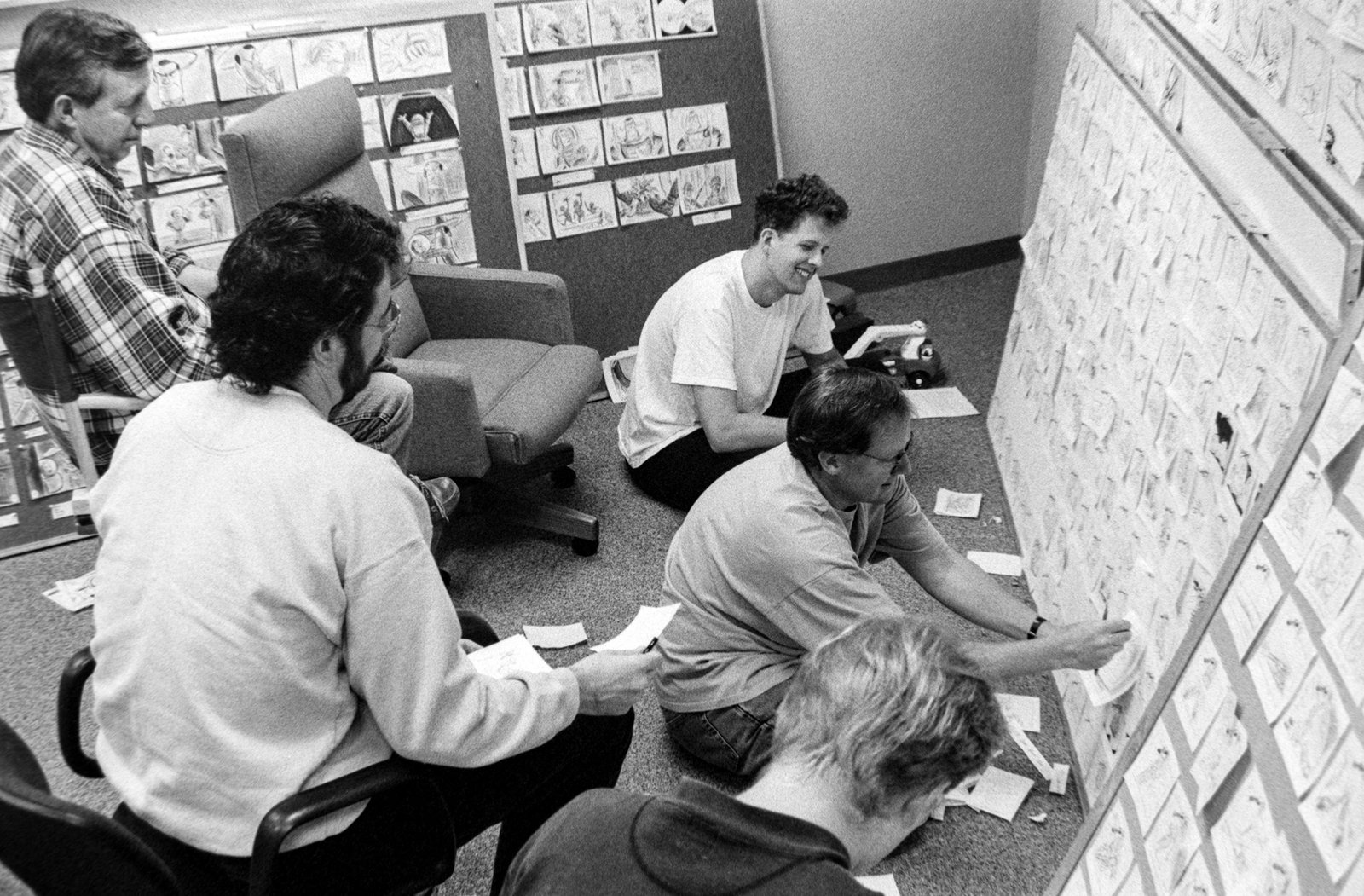
Lasseter gave notes faster than anyone could write them. Storyboard artists kept Post-It pads in their hands. “Make that wider.” “Different angle.” “He wouldn’t say that.” Stick it on the board. Move on. By the end of a session the boards were a forest of yellow squares.
For the play: when an idea lands at the table, somebody might literally pull a Post-It out of a pocket and scribble. This is character business.
Trust the process
Ranft’s mantra at Pixar — adopted by everyone after him. The phrase meant: don’t panic when the work is bad in week six, that’s the work being bad in week six. The story always sucks in the middle. Stanton’s later version: “One thing every Pixar film since then has shared with Toy Story is that, at some point in production, it sucks. The trick is not stopping there.”
Story is testing, not refining
Stanton’s most-quoted principle — and one he was almost certainly already saying in 1994. The team did not assume the first version was the real one. They pitched, screened, broke, re-pitched, re-broke. A bad reel was data, not a problem.
Re-boarding
“Storyboarding is really re-boarding,” Ranft said. “Your first idea is never good enough.” A Bug’s Life used 27,500 storyboard drawings; they tossed away many more than that. The four men at the table treated ideas as drafts by default.
Write the cliché first
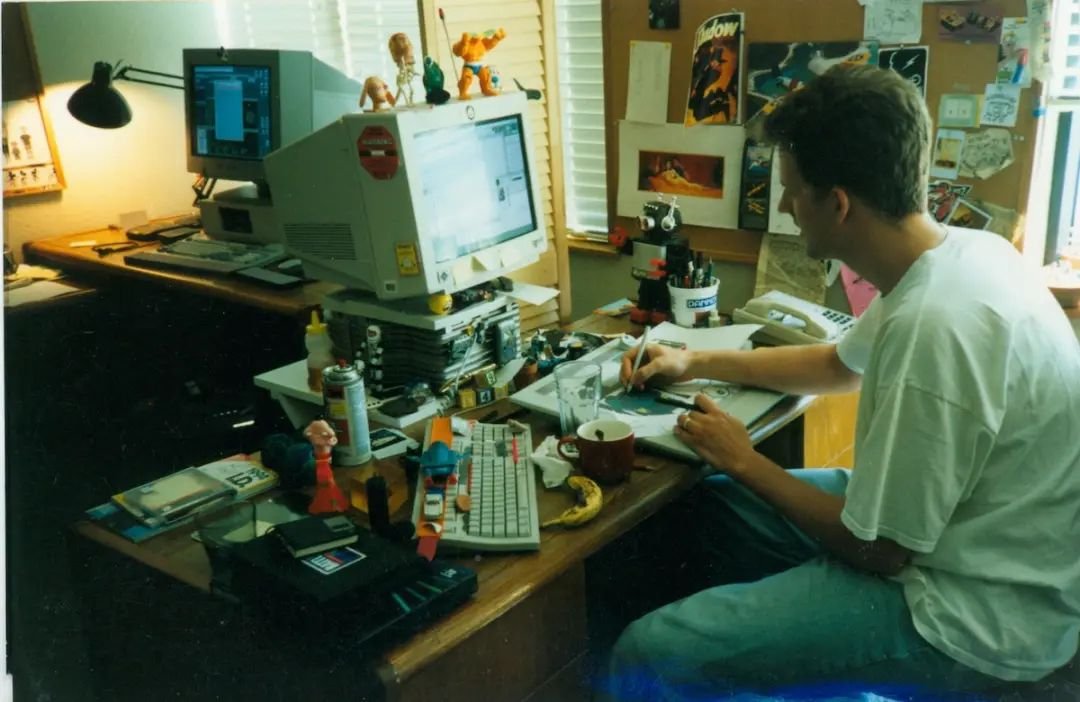
Docter’s process, in his own words, in a 2012 Reddit Q&A (via Pixar Post): “Write the cliche first, then recognize you just wrote a cliche and rewrite it. Repeat until your scene works. Our secret here is that we make 8+ lousy versions of every film that we change until we think it’s good enough for you to see it.”
This is the operative method behind “story is testing.” The first version is allowed to be bad; the bad version is the data; the good version comes by attrition.
Art is messy
Stanton to The New Yorker, 2009 (Tad Friend profile): “Art is messy, art is chaos — so you need a system.” The line, said years later, is also the team’s posture at the lunch. They are making a system as they speak.
What was on the table
- Pads of paper napkins — the only “official” record of the meeting. Sketches went directly onto them.
- Each man’s own sketchpad. Ranft especially carried small index-card-sized notebooks for jotting gags.
- Pens, pencils. Lasseter probably had a fountain pen — he was a craftsman about his tools.
- Coffee cups. The café had a Chez Panisse-influenced kitchen but also a working diner counter.
- The check, eventually. Almost certainly Lasseter paid — director, senior man at the table.
VI.
The Brain Trust, Before It Was the Brain Trust
This is the thematic claim a writer can hang the play on: we are watching an institutional ritual being born.
Pixar’s most famous management practice is the Brain Trust — round-table critique meetings where directors tear into each other’s films. Ed Catmull describes it in Creativity, Inc. (2014) as Pixar’s “primary delivery system for straight talk.” Elsewhere in the book: “I like to think of the Braintrust as Pixar’s version of peer review, a forum that ensures we raise our game — not by being prescriptive but by offering candor and deep analysis.”
Catmull is explicit about its origin. He writes: “The Braintrust developed organically out of the rare working relationship among the five men who led and edited the production of Toy Story — John Lasseter, Andrew Stanton, Pete Docter, Lee Unkrich, and Joe Ranft.” An important precision: the name “Brain Trust” did not exist in 1994. Per Catmull, the term itself became official during the Toy Story 2 production crisis (1998–1999). In 1994 the dynamic exists; the institution has not yet been named. The play is watching a future institution before it has a word for itself.
Four of those five are at this lunch. Unkrich joins Pixar later in 1994 as Toy Story’s editor. What’s happening at Hidden City is the Brain Trust’s first known instantiation, before the institutional ritual existed. They are doing it without knowing they are inventing it.
Catmull on what made it work — “They were funny, focused, smart, and relentlessly candid when arguing with each other. Most crucially, they never allowed themselves to be thwarted by the kinds of structural or personal issues that can render meaningful communication in a group impossible” — describes exactly the dynamic the play is set inside.
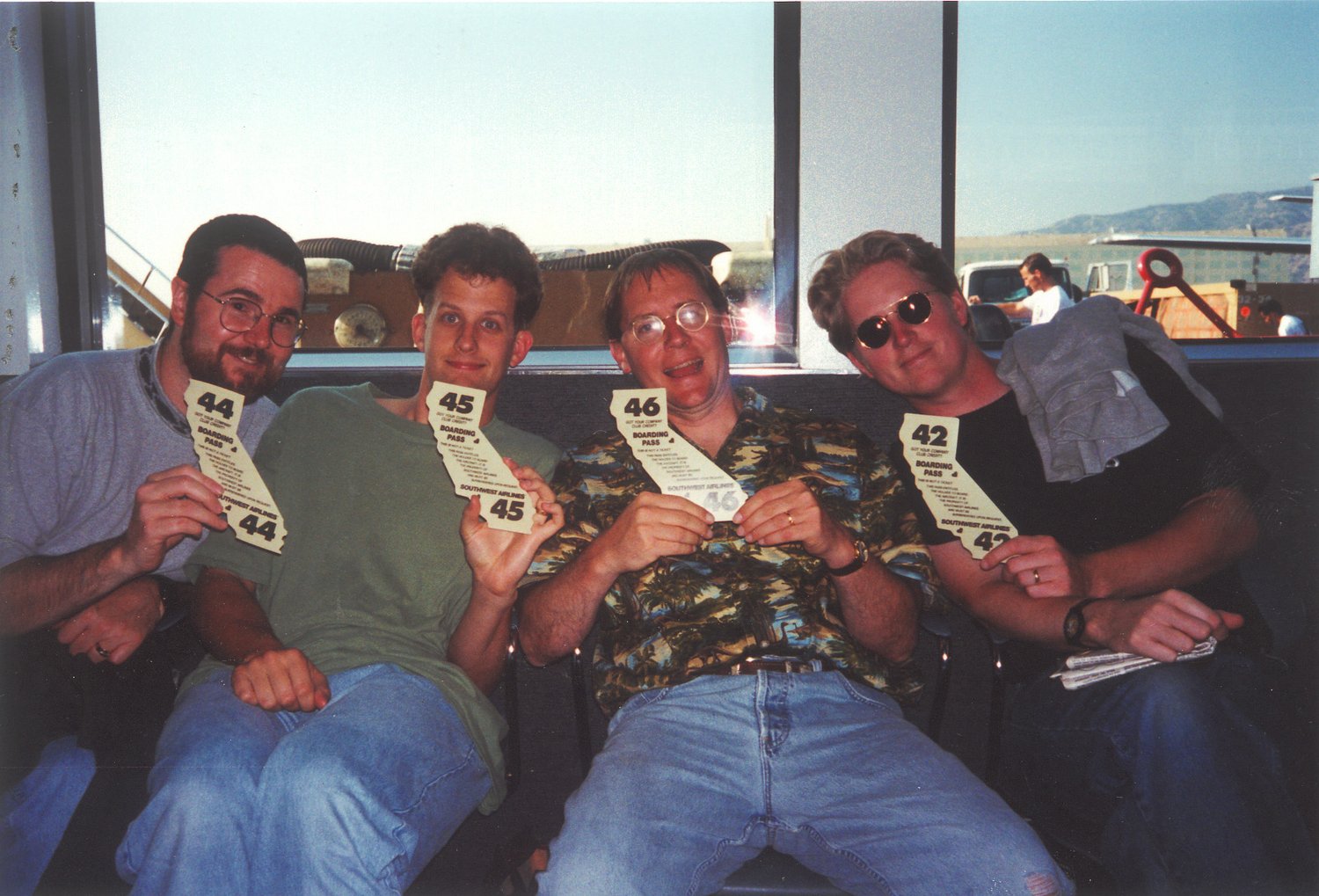
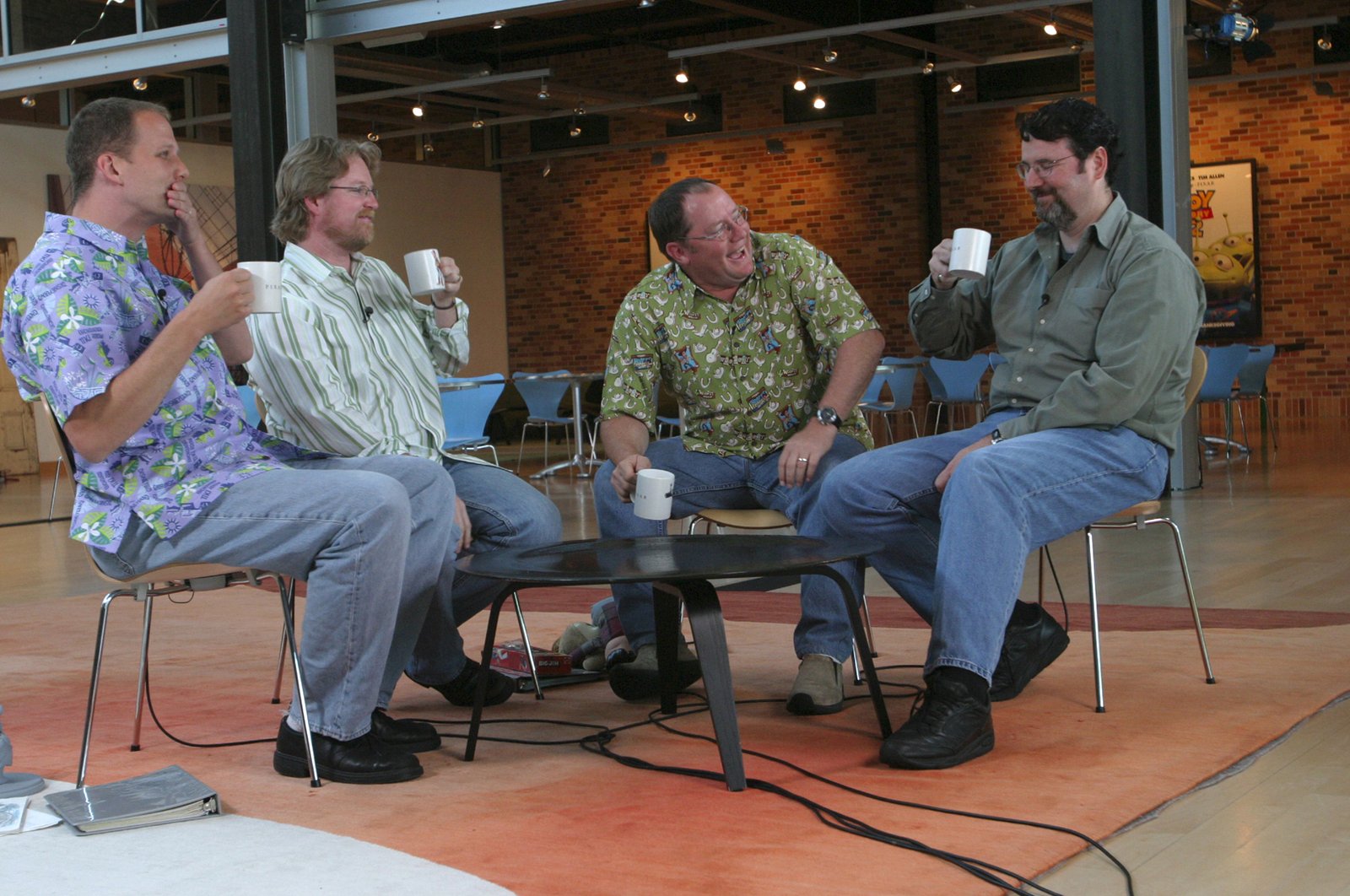
In their own words
The four described the dynamic themselves in the 2005 round-table Toy Story: Filmmakers Reflect — the only recorded conversation of all four together, filmed in the last months of Ranft’s life. It is the closest thing on the record to the play’s own form: the four men at a table, finishing each other’s sentences. Docter on the chemistry — “I don’t even think we could take credit for it. This chemistry that we fell into, the four of us. When we’d be boarding stuff and trying to hash things out… we just loved to argue. I think we kind of scared people, because we’d get so loud and we’d get in each other’s faces, and people would think we hated each other. But the truth is, we were actually hoping we’d be proven wrong. There was such a desire to get the answer.”
What emerged, in Stanton’s telling, was “one mind” — half-jokingly, the Super Friends: everyone working the same sequence at once, one man drawing one row of boards while another drew the next and a third cleaned up a fourth’s panel. And the line a writer should pin above the table, from the same conversation: “It’s not so much talent. It’s just about whether you can get along.” This is the dynamic the play stages — the loud argument that looks like a fight and is actually love.
The band, in Stanton’s own words (2026)
Thirty-two years on, Stanton reached for the play’s central metaphor unprompted. Describing the moment around the 1995 IPO when the group was told it would have to split up to direct separate films, he said it felt like “telling the Beatles, now that you’ve finally figured out how to work as a group, you’ve got to make solo albums.” He called the original five “a garage band” that “figured itself out,” and the Brain Trust the workaround — the band agreeing to keep meeting after the label forced the solo careers. (How I Write, June 2026.)
Two more details from the same passage, both load-bearing. First, his accounting of the group’s later decline is a stage direction: five people in a room means everyone’s involved; past ten, “there’s an audience” — people perform, people hide, safety dies. The play’s form (four at a table, plus the one who serves them) sits exactly on the right side of that line. Second, his reference to Ranft’s death is four words — “one of us passed away” — delivered in passing, unelaborated. That is the register the play asks of its audience: the loss carried, never announced.
Serendipity by design — and its second home
A producible thematic note for the play. Walter Isaacson’s Steve Jobs (2011) records that when Jobs later designed Pixar’s Emeryville campus, he engineered a single central atrium that everyone had to walk through to reach restrooms, mailboxes, screening rooms, and the café — because, he told Isaacson, “the key to creativity is serendipity.” He believed the best ideas came from unplanned encounters between people from different departments.
Hidden City Café, in 1994, was the same idea before Jobs had built the architecture for it. Two blocks from the studio, communal seating, the four senior creative leads bumping into each other at lunch. The play is set inside an accidental version of the system Jobs would later try to engineer. The institution did not invent the conditions. The conditions invented the institution.
VII.
Story Principles Already in the Air
Several phrases that later became Pixar doctrine were already being said — or about to be said — in 1994. A writer can put any of these into a character’s mouth as a fresh, just-coined-now line. Dramatic irony of language.
The most useful, though, is the negative manifesto — the rules they set by refusing the form. In the 2005 round-table the four recalled the founding rebellion almost in unison: no breaking into song, no fairy tale, no villain, and the supporting players should be as funny as the leads. Stanton: “All the stuff that had become synonymous with animation in the popular culture — ‘oh, it’s animated, that means it must be a musical, and it must be a fairy tale.’ For me that was the biggest motivator through all the hard times — just wanting to prove that theory wrong. That you can truly entertain an audience, adults as well as kids.” In 1994 that conviction is already the room’s spine. It is exactly the kind of thing one of them might say at the table as if coining it on the spot.
- “Story is testing, not refining.” Stanton’s. The team’s working method.
- “Trust the process.” Ranft’s mantra. Don’t panic when the work is bad in week six.
- “It always sucks in the middle.” Pixar adage. The corollary to “trust the process.”
- “Storyboarding is really re-boarding.” Ranft. The first version is never the right version.
- “Make me care.” Stanton’s orienting question for any pitch. He gave a TED talk around this in 2012.
- “You admire a character for trying more than for their successes.” From story artist Emma Coats’s 22 Rules of Storytelling (2011) — her personal observations from the story room, not studio doctrine (see caveat below).
- “What is your character good at, comfortable with? Throw the polar opposite at them.” Also Coats. Same caveat.
- “Coincidences to get characters into trouble are great; coincidences to get them out of it are cheating.” Also Coats. Sounds like Stanton — but attribute to Coats only.
- The Egri premise sentence. Lajos Egri, The Art of Dramatic Writing (1946): a one-sentence premise of character → conflict → conclusion. Stanton names it his foundational text and says he read “every book that there is” on the craft — this is the one that stuck. His Nemo premise: “fear denies a good father from being one.” Period-legitimate: the book predates the lunch by half a century, and Stanton at the table is exactly the kind of young craftsman who has read it. (How I Write, June 2026.)
- “Drama is anticipation mingled with uncertainty.” William Archer, Play-Making (1912). Stanton calls it the best definition of drama he’s ever heard; his working image is the San Francisco cable car — the story either clamps onto the moving chain or it doesn’t, and his whole diagnostic is “when did we accidentally unclamp?” Doubly period-legitimate: Archer is eight decades old at the lunch, and cable cars are the local metaphor. (How I Write, June 2026. Now also embedded in the treatment as the play’s drama engine — see Treatment v2.1, “The Clamp.”)
- “Surprising in the moment, inevitable in retrospect.” Aristotle, by way of the same interview — Stanton’s standard for an ending. The empty-table ending should be held to it.
Caveat — the “22 Rules” are not Pixar doctrine. Stanton went on the record in the June 2026 interview: the 22 Rules were “not generated by us,” there has never been an internal rule book, and the list circulating as official Pixar methodology is, in his word, a myth — “just because it’s online doesn’t mean it’s real.” The rules remain useful as one artist’s observations; they must never be cited (in the play’s marketing, deck, or dialogue) as the studio’s creed. This is exactly the mythology-creep this dossier exists to catch.
Use these sparingly. Putting all of them in the play would feel like a TED-talk montage. Putting one in the right character’s mouth at the right beat is gold.
VIII.
The Afternoon After
Useful for any writer making structural choices about epilogues, flashforwards, or what happens when the lights come up on the empty table.
They paid the check. They walked the two blocks back to 1001 W. Cutting Boulevard. They returned to Toy Story. The reels were still being assembled. Disney was still giving notes. Hanks had recorded his new dialogue in March; Allen too. The animators were in the trenches. Lasseter was three months out from his second Christmas-in-a-row of essentially not seeing his family.
The crew was about 100 people. By Toy Story’s release in November 1995 it would be 110. Most had moved to Point Richmond from elsewhere. Some were sleeping in the office. Galyn Susman, character TD and lighting supervisor, would have a baby in 1998 — which is why she had a server backup at home that would later save Toy Story 2.
Toy Story 2’s near-death incident was four years away. A Bug’s Life production was three years away. WALL-E’s was twelve. None of them knew.
And there is a quieter irony the four named only in hindsight. Through the whole ordeal, Stanton has said, he assumed Toy Story was the only film they would ever make: “I pretty much remember feeling, up until maybe six months before the movie came out, that as far as I was concerned, this was our only shot. We weren’t going to make more than that. This was it.” The drive came precisely from that belief — “you never took it for granted… we were making this for ourselves. It really was the most selfish moviemaking.” That is the engine of the lunch in a sentence: four men casually dreaming up the next thirty years of cinema while privately convinced they may never get to make another film at all.
IX.
The Wider Cast (1994)
Pixar in 1994 was about 100 people. Several were already, or were about to become, names.
Ed Catmull
Co-founder. President. Quiet, methodical, technical visionary. Earned his Ph.D. in computer science at Utah with the explicit goal of making the world’s first computer-animated feature. By 1994 he’d been working toward that for nineteen years. Wrote Creativity, Inc. (2014). Retired 2019.
Steve Jobs
Owner. Bought Pixar from George Lucas in 1986 for $5 million, put another $50 million in over the next decade. In 1994 he’d been out of Apple for nine years and was running NeXT, which was struggling. Pixar was the lab where he was figuring out what he wanted to be next. Returns to Apple 1997.
Almost certainly not at this lunch. But a phone call away. He is the money. He is impatient. A check-in call to the table is plausible.
2026 texture, from Stanton — In meetings Jobs would sit with hands pressed together — “a namaste hand” — and let the room hold silence as long as it took for the right answer to surface. The verdict circulating at Pixar when Stanton arrived: if Jobs thinks he can do your job, he’s the worst boss alive; if he knows he can’t, the best — and he knew he couldn’t do what the animators did. Stanton frames the era directly: “his 10 years in the desert was with Pixar.” And the reason Jobs stayed: he told Lasseter that anything he built in computers had a shelf life of about five years, but Pixar was making something people might watch for decades — the next Snow White. For the play’s offstage presence, this is gold: the impatient owner is also, privately, the truest believer at the company. (How I Write, June 2026.)
Alvy Ray Smith
Co-founder. Brilliant graphics researcher who clashed with Jobs and was on his way out by 1994 — resigned 1991, left officially 1994. Probably not at the table; a name that could come up.
Joss Whedon
Yes — that Joss Whedon. In 1994 he was 30, a script-doctor-for-hire who’d written the Buffy film (1992). Brought in after Black Friday to help fix Toy Story. Worked with Lasseter, Stanton, Docter, and Ranft on the rewrite.
His specific contributions: added Rex; transformed Buzz from self-aware to delusional (the script’s central pivot); pitched a Sarah Connor-style commando Barbie that Mattel refused to license — became Bo Peep. Oscar-nominated for the screenplay.
Goes on to create Buffy the TV show, Angel, Firefly, Serenity, Dollhouse — then writes and directs Marvel’s The Avengers (2012) and Age of Ultron (2015). Post-2017 his reputation collapses amid multiple credible misconduct accounts.
Toy Story creative team — and what they later became
- Bonnie Arnold — Producer of Toy Story. Later produces How to Train Your Dragon (2010) and runs DreamWorks Animation features.
- Ralph Guggenheim — Co-producer of Toy Story. Leaves Pixar around its release.
- Joel Cohen & Alec Sokolow — The two writers Disney brought in mid-1993 whose draft, per the team, “did all the damage they could to the script.”
- Ralph Eggleston — Art director of Toy Story. CalArts. Later directs For the Birds (2000, Oscar for Best Animated Short). Dies of pancreatic cancer in 2022 at 56.
- Lee Unkrich — Joins Pixar in 1994 as film editor on Toy Story. Later co-directs Toy Story 2 (1999) and Monsters Inc. (2001), then directs Toy Story 3 (2010, Oscar) and Coco (2017, Oscar). The fifth man Catmull names as a founder of the Brain Trust.
- Galyn Susman — Character TD and lighting supervisor on Toy Story. Pixar legend as the person whose home backup saved Toy Story 2 in 1998 — a server-side
rm -rfnearly destroyed the film. - Bob Peterson — Joins Pixar story team in 1994. Co-writes Finding Nemo, voices Roz in Monsters Inc., co-directs Up (2009, Oscar).
- Ash Brannon — Animation director on Toy Story. Co-directs Toy Story 2 (1999), directs Surf’s Up (2007).
- Bud Luckey — Designed Woody. Later voices Eeyore in Winnie the Pooh (2011) and Rick Dicker in The Incredibles. Dies 2018.
- Jeff Pidgeon — Storyboarded Sid’s room with Ranft. Voices the Squeeze Toy Aliens. Still at Pixar.
- Bill Reeves — Supervising technical director. Co-developed RenderMan and Marionette. Two Scientific & Engineering Oscars (1997, 1998).
CalArts classmates working elsewhere in 1994
- Brad Bird — Making The Simpsons; noodling on The Iron Giant (1999). Joins Pixar around 2000. Two Oscars: The Incredibles (2004) and Ratatouille (2007). Directs Mission: Impossible — Ghost Protocol (2011).
- Tim Burton — By 1994 has done Beetlejuice, Batman, Batman Returns, Edward Scissorhands, The Nightmare Before Christmas (1993, story-developed in part by Ranft). Ed Wood opens October 1994.
- Henry Selick — Directed The Nightmare Before Christmas (1993). Later: James and the Giant Peach (1996, on which Ranft also worked), Coraline (2009).
- John Musker — At Disney, fresh off The Little Mermaid (1989) and Aladdin (1992). Later: Hercules (1997), The Princess and the Frog (2009), Moana (2016).
- Chris Buck — At Disney, working toward Tarzan (1999), then Frozen (2013) and Frozen II (2019).
Toy Story voice cast — already in the room in 1994
- Tom Hanks (Woody) — Coming off Philadelphia (1993, Oscar) and Forrest Gump (1994, Oscar). The biggest star in Hollywood.
- Tim Allen (Buzz Lightyear) — Home Improvement is the #1 show on television.
- Don Rickles, Wallace Shawn, Jim Varney, John Ratzenberger, Annie Potts, R. Lee Ermey, Laurie Metcalf — the ensemble.
Disney — the distant overlords
- Jeffrey Katzenberg — Head of Disney’s film studio. Approved Toy Story in 1991. Resigns from Disney in August 1994 — during this lunch — after Eisner passes him over following Frank Wells’s death. Co-founds DreamWorks SKG with Spielberg and Geffen on October 12, 1994, each investing $33M. That melodrama is happening in real time.
- Peter Schneider — Head of Disney animation. Pulled the plug on Toy Story in November 1993.
- Roy E. Disney — Walt’s nephew. Watched Black Friday. “You seriously listened to us?”
- Tom Schumacher — Katzenberg’s colleague who, when asked why the Toy Story reels were bad, said: “Because it’s not their movie anymore.”
X.
The Body of Work They Already Had
By 1994 Pixar had made five short films. These were the team’s only feature-length-adjacent body of work — the EPs before the album.
- The Adventures of André & Wally B. (1984) — Pre-Pixar, made at Lucasfilm. Directed by Alvy Ray Smith. Lasseter’s first work in computer animation.
- Luxo Jr. (1986) — Two minutes. Two desk lamps — a parent and a child — playing with a ball. Lasseter directed. Academy Award nominated. The smaller lamp became Pixar’s logo. Established that computer animation could communicate character and emotion.
- Red’s Dream (1987) — A unicycle in a bicycle shop dreaming of circus glory. Lasseter directed. First test of PhotoRealistic RenderMan.
- Tin Toy (1988) — A wind-up musician toy tries to befriend an enormous, destructive baby. Won the Academy Award for Best Animated Short — first CGI film ever to win an Oscar. Proof-of-concept that led directly to Toy Story.
- Knick Knack (1989) — A snowman tries to escape his snow globe to join the Miami-themed bobbleheads partying nearby. Lasseter directed. Music by Bobby McFerrin.
That’s it. Twelve minutes of cinema total. Built mostly to show off Pixar’s RenderMan software and the Marionette animation system (internally called Menv) — not as art for its own sake.
The feature that almost happened first
Toy Story is the first Pixar feature to reach the screen. It is not the first Pixar feature attempt. In the mid-1980s, before Toy Story was a glimmer, Pixar was in discussions with a Japanese publisher about a film to be called “Monkey,” based on Japanese and Chinese mythology. There were story meetings. Concept art. The publisher was ready to invest tens of millions of dollars. (David A. Price, The Pixar Touch, 2008.)
Catmull and Alvy Ray Smith concluded that the technology wasn’t ready — a fully computer-animated feature wasn’t yet economically feasible — and the project died. The lunch in 1994 is the second time these men are imagining a Pixar feature future. They have already lost one. The audience does not know this; the writer can let the men carry it without ever naming it.
XI.
The Competition in 1994
Computer animation as a feature-film medium does not yet exist. Toy Story will be the first. The four men know that no one else is doing what they are about to do.
- Disney hand-drawn animation — At its commercial peak. The Lion King opened June 15, 1994, becomes the highest-grossing animated film ever. Disney is the giant whose distribution Pixar lives inside, and the company that just nearly killed Toy Story.
- DreamWorks SKG — Being formed as Pixar holds this lunch. Katzenberg, Spielberg, Geffen announce on October 12, 1994. Antz — DreamWorks’ first animated feature — will come out in 1998, six weeks before A Bug’s Life. The two films are about ants. Lawsuits and accusations follow.
- Don Bluth — Still active. The Pebble and the Penguin in 1995, then Anastasia (1997) and Titan A.E. (2000).
- Industrial Light & Magic — Just delivered Jurassic Park (1993). CGI for live-action is exploding. Pixar’s RenderMan is industry-standard rendering software at ILM and elsewhere.
- Nickelodeon Animation Studios — Founded 1990. By 1994 Rugrats and Doug are hits.
- Hanna-Barbera, Klasky-Csupo, Film Roman — TV animation houses. The Simpsons is on Fox; Brad Bird is there.
XII.
Money in 1994
This tension lives in the room even if nobody names it.
- Pixar lost $2.4 million in 1994 on $5.6 million in revenue. The company had not turned a profit since being spun out by Jobs in 1986.
- Steve Jobs personally funded shortfalls year after year. By 1994 he had put roughly $50 million into Pixar on top of the original $5 million purchase. His net worth had collapsed since being fired from Apple in 1985.
- Pixar animators were paid less than Disney animators. Several considered jumping ship. Disney was actively trying to recruit Pixar talent.
- Lasseter’s directing contract for Toy Story did not give him meaningful upside. The Pixar IPO that would change everything is more than a year away (November 29, 1995, a week after Toy Story’s release).
- Toy Story’s budget was $30 million. Disney was paying. If it failed, Pixar would probably not get a chance to make another.
None of the four are getting rich at this lunch. They are betting their twenties and thirties on a thing that might not work.
XIII.
Comparable Plays — and What They Got Right
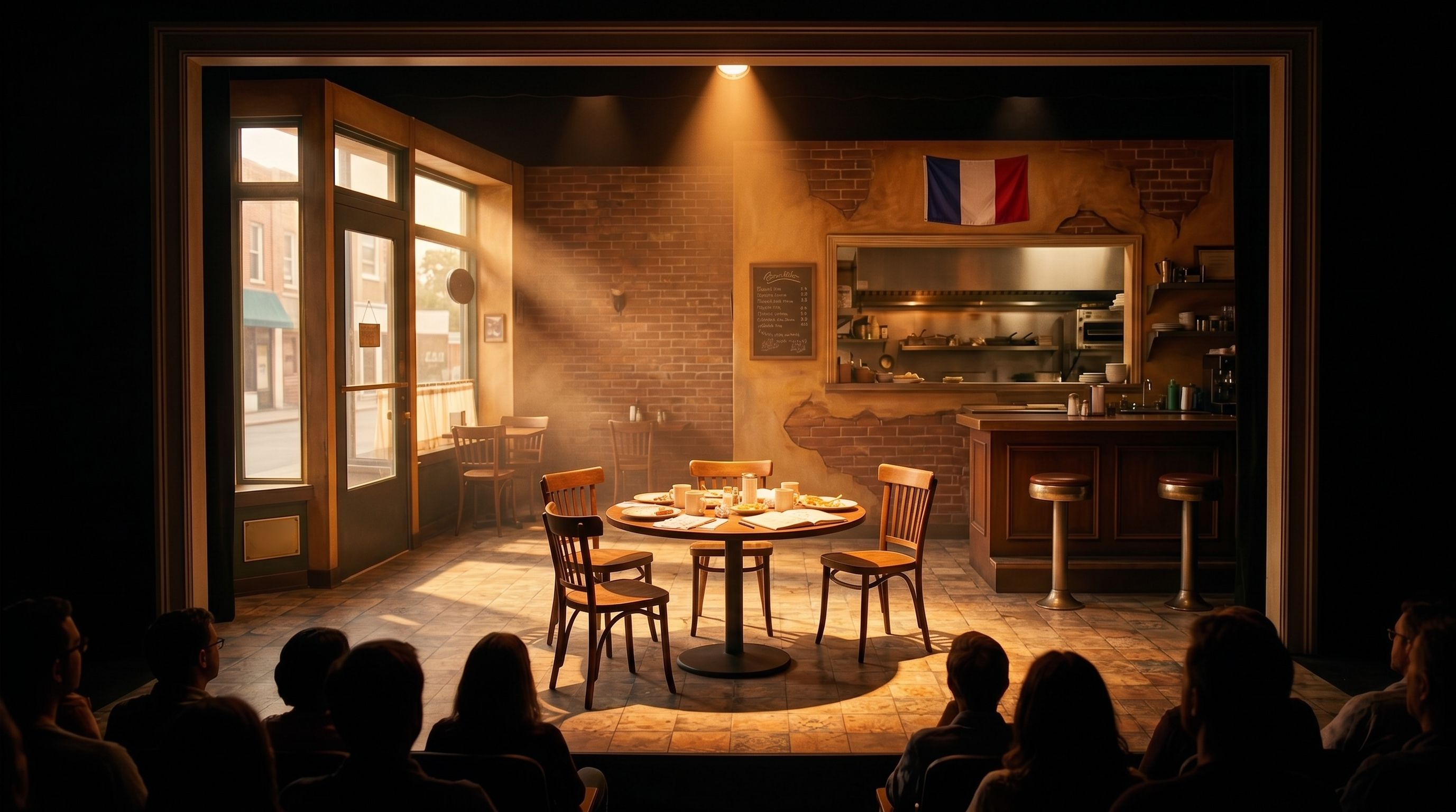
A short reference section on how other writers handled the living-real-people problem.
- Matt & Ben (Mindy Kaling & Brenda Withers, 2002) — The original cultural-arbitrage move. Off-Broadway. Absurdist. The Good Will Hunting script falls from the ceiling. Showed you can build an original play in the negative space around real public personas. Legal posture: pure satire, transformative, no defamation claim possible.
- Frost/Nixon (Peter Morgan, 2006) — Two-hander about the 1977 Frost-Nixon interviews. Tight chamber piece, lots of invented dialogue, both men still alive at premiere. Transferred from London to Broadway, then became a Ron Howard film.
- Amadeus (Peter Shaffer, 1979) — The model for the dramatic-irony layer. Salieri tells us nothing about Mozart’s death we don’t already know. Every scene is haunted by the future.
- Stereophonic (David Adjmir, 2024) — A play about a 1976 rock band recording their breakthrough album. Almost-but-not-quite Fleetwood Mac. The most recent and most relevant comp. Tony for Best Play. Plays-with-songs format.
- The Social Network (Sorkin, 2010 — film, not play) — Different medium, same DNA: four-ish characters in rooms inventing the future of culture, all of them still alive at premiere. Zuckerberg actively opposed it. Got made anyway.
- Red (John Logan, 2009) — Two-hander about Mark Rothko painting the Seagram murals. Tony for Best Play. Useful for the “watching artists work” dramaturgy.
- Doubt (Shanley, 2004) — Not a real-events play but a chamber piece. Pulitzer and Tony. Worth studying for how to keep four people in a single ethical pressure cooker for 90 minutes.
- The Lehman Trilogy (Massini / Power, 2013/2018) — Three actors play multiple generations of one family across 150 years. Worth studying for how to compress vast historical time onto a single stage.
XIV.
Legal Landmines — Named
Not a legal opinion. A flagged list for the eventual clearance-attorney conversation.
- Lasseter — Alive. Currently running Skydance Animation. Reputation rehabilitation is his explicit current project. Highest litigation risk. Mitigation: depict him strictly as he was in 1994 — unproven, fighting for an unreleased film, years before any rise or fall — without foreshadowing 2017. Don’t invent dialogue suggesting misconduct. Let dramatic irony do the work.
- Docter — Alive. Currently Chief Creative Officer of Pixar. He runs the studio that owns the IP of every film discussed at the lunch. His participation, blessing, or active opposition shapes the project’s distribution ceiling. Lowest defamation risk; highest IP-and-access risk.
- Stanton — Alive. The original on-record narrator of the story. Most likely to be supportive. Low risk.
- Ranft — Deceased 2005. Estate-of considerations rather than defamation considerations. His widow Sue Barry and brother Jerome are the relevant approvals. The play is most likely to be received as a tribute by them — but they should be approached early, not late.
- Trademark exposure — Pixar, Disney, Lucasfilm, Hidden City Café, Luxo Jr., Toy Story, A Bug’s Life, Monsters Inc., Finding Nemo, WALL-E, RenderMan — all are trademarks. Saying them on stage is generally fine (nominative fair use). Putting them on the poster is a different question. Putting them in the title is the highest-risk version.
- Invented dialogue — Standard for the form. The four men can say things they never said. The risk is dialogue that crosses into actionable defamation — false statements of fact about a living person that would damage them. Opinion, satire, and transparently dramatized scenes are protected.
- The Joss Whedon question — If he becomes a character (even off-stage), his post-2017 reputation collapse means he is now in a litigation-cautious position. Probably fine in the same way Lasseter is fine: 1994-only, no foreshadowing.
- Theater vs film posture — Stage play in a 99-seat house is the lowest-risk form. Off-Broadway is slightly higher. Filmed version, especially streaming, is meaningfully higher. The producer move is play first, optionality second.
Get a 30-minute call with an entertainment clearance attorney before the script goes to any public reading. Cost: $500–$2,000 for a read and a letter. Cheap insurance.
XV.
Glossary
Terms the four men would use casually. Audience will not all know them. A writer should know which need setup.
- Brain Trust (also Braintrust) — Pixar’s round-table critique meetings. Doesn’t exist by name in 1994 but the practice is being invented at this lunch.
- Storyboard — Sequence of drawings depicting a film scene, pinned to a wall. The basic unit of animation pre-production.
- Story reel (also Leica reel) — Storyboards filmed in sequence, cut to dialogue and rough sound, to test a sequence’s timing before animation begins. Pixar would re-cut these dozens of times per film.
- Pitch — Standing in front of pinned boards and acting out the sequence. Performance, not presentation.
- Notes — Feedback from the director or executive. “Disney notes” were specifically dreaded after Black Friday.
- Scratch track — Temporary voice recording, often done by the story artist themselves, used in story reels before the real actor records.
- In-betweens — Drawings between key poses. In hand-drawn animation, an entire job category. At Pixar the computer does it.
- Key pose — The defining drawings in a sequence of action.
- Tone meeting — Director and voice actors discussing emotional read before recording.
- RenderMan — Pixar’s proprietary rendering software, released 1988. Industry-standard. Won three Sci-Tech Oscars. Used on The Abyss, Terminator 2, Jurassic Park.
- Marionette (internally: Menv, “men-vee”) — Pixar’s proprietary animation system. Not for sale. Used in-house only.
- SIGGRAPH — The annual computer graphics conference where Pixar premiered most of its early shorts.
- Black Friday — November 19, 1993. The day Disney shut down Toy Story production after a disastrous storyboard reel.
- CalArts — California Institute of the Arts. The Disney-funded animation program that produced Lasseter, Stanton, Docter, Ranft, Bird, Burton, Selick, Musker, Buck, and a whole generation.
- Nine Old Men — Disney’s core animators from the Walt era. Three of them (Eric Larson, Frank Thomas, Ollie Johnston) taught Lasseter at CalArts. The lineage from Walt is exactly three steps to this table.
XVI.
The Afterlife of Each Idea
For a writer making structural choices about epilogue, framing, or what the audience knows at curtain — a quick map of what the four ideas became.
A Bug’s Life — released November 25, 1998
Directed by Lasseter and Stanton. Box office $363M against an $80M budget. Released six weeks after DreamWorks’ Antz — both films about ants, leading to bitter accusations between Katzenberg and Lasseter that have never fully resolved. The first film built on the Hidden City lunch.
Monsters Inc. — released November 2, 2001
Pete Docter’s directorial debut. Box office $529M. The film opens with the Hidden City Café in the background of the monster city — the lunch immortalized in the film it produced.
Finding Nemo — released May 30, 2003
Stanton’s directorial debut. Box office $871M — at the time, the highest-grossing animated film ever. Won the Academy Award for Best Animated Feature.
WALL-E — released June 27, 2008
Stanton’s. Fourteen years from the lunch to the screen. Box office $521M. Academy Award for Best Animated Feature. Considered one of the greatest animated films of the 21st century. The teaser trailer — released June 2007 — is where Stanton tells the story of the 1994 lunch on camera. The Hidden City Café is the setting of the teaser. The play is, in a sense, a feature-length expansion of that 90-second monologue.
And six more films directly traceable
- Toy Story 2 (1999) — Stanton co-wrote, Unkrich co-directed.
- Finding Dory (2016) — Stanton directed; Finding Nemo sequel.
- Cars (2006) — directed by Lasseter, dedicated to Ranft.
- Monsters University (2013) — prequel to Monsters Inc.
- Up (2009) — Docter, Oscar.
- Inside Out (2015), Soul (2020) — Docter again. The through-line from this lunch is unbroken.
By any reasonable count, the four men at this table directed, wrote, or supervised the story on virtually every Pixar feature for thirty years.
XVII.
Working References
Each cited primary fact in this dossier is anchored to one of the sources below. Sources are grouped by type.
Stanton, in his own words
- WALL-E teaser trailer (Pixar, June 2007) — the only first-person account of the lunch on the record. Used for the cover-quote in Section I.
- The Post and Courier interview (2008), via Business Insider (April 2014) — the “something special” quote about the four men in a room.
- WALL-E production notes (Pixar, 2008) — the extended “robot left on Earth” quote and the “most human thing left in the universe was a machine” line.
- Cinema Blend interview (June 2008) — the binoculars-at-a-baseball-game story and Stanton’s direct “I missed the entire inning” quote.
- FirstShowing interview (July 2008) — Stanton’s confirmation that the WALL-E design epiphany was “late 2003,” nine years after the lunch.
- TED Talk (March 2012), “The clues to a great story” — the “Make me care” framework.
- The New Yorker, Tad Friend profile (2009) — “Art is messy, art is chaos — so you need a system.”
- Peter Sohn on the BroBible Post-Credit Podcast (2022) — Stanton at the SF Giants game asking “Doesn’t that create empathy?”
- Toy Story: Filmmakers Reflect (2005) — the 17-minute 10th-anniversary round-table with all four filmmakers, released on the Toy Story 10th Anniversary Edition DVD (Sept 6, 2005), filmed in the last months of Ranft’s life. Source for Stanton’s “this was our only shot” and “the most selfish moviemaking” reflections, the “prove that theory wrong” manifesto, and the “buddy picture” / Toys “R” Us origin beats. The only filmed conversation of all four men together.
- How I Write podcast, hosted by David Perell — “Andrew Stanton: Storytelling Secrets from the Writer of Toy Story 5” (video published June 24, 2026; also on the show’s Substack and podcast feed, early July 2026). Newest first-person account of the brainstorm (“just the four of us… spewed a bunch of subject matters”); source for the Trash Planet working title, the futility genesis, the Docter-shelved / Stanton-resumed custody chain, the box-and-circle romance conviction, the Beatles/solo-albums quote, the garage-band framing, the five-versus-ten room-size principle, the Jobs texture (namaste silence, ten years in the desert, next Snow White), the Egri premise method and the Nemo premise sentence, the Archer “anticipation mingled with uncertainty” endorsement and cable-car clamp, and the on-record debunk of the “22 Rules of Pixar Storytelling.” Full transcript on file. Rot-risk: low (YouTube), but archive the Substack page.
Docter, in his own words
- Reddit Q&A as PixarPete (December 2012), summarized on Pixar Post — the Monsters Inc. origin quote about the closet, the screams-as-power-source, and the “write the cliche first” principle.
- Toy Story: Filmmakers Reflect (2005), round-table — Docter’s account of the four-way chemistry: “we just loved to argue… we were actually hoping we’d be proven wrong.” (Full citation under Stanton, above.)
Ranft, in his own words
- Disney Institute interview (April 23, 1999), recorded by Jim Korkis — the purple sweatshirt observation, the “re-boarding” principle, the Lasseter-Whittier-pact details.
- LA Times interview (1999) — the explicit pact: “John and I had a pact that when he directed his first feature, I was going to work on it.”
- Green Army Men pitch (Toy Story 20th Anniversary release) — the canonical document of how Ranft actually pitched at the storyboard wall.
Catmull, in his own words
- Creativity, Inc. (Ed Catmull with Amy Wallace, 2014) — the Brain Trust origin claim (five men, four at the lunch), the “primary delivery system for straight talk” framing, the “peer review” framing.
Secondary aggregations
- David A. Price, The Pixar Touch (2008) — canonical narrative history. Source for the Monkey near-miss and the Black Friday narrative.
- Walter Isaacson, Steve Jobs (2011) — Jobs-side perspective on Pixar funding, 1994 net worth, the post-Apple decade. Source for the atrium-as-serendipity design philosophy.
- Karen Paik, To Infinity and Beyond! (2007) — official Pixar history. Source for the Lasseter + Stanton brainstorming attribution on the Aesop’s Ant and Grasshopper flip, the early Pixar shorts genealogy, and the Toy Story production timeline.
- Stacey Kennelly, “Point Richmond restaurateur earns entrepreneur award” — Richmond Confidential, UC Berkeley Graduate School of Journalism (November 14, 2011). Source for Shellie Bourgault’s biography including Chez Panisse training, Bay Area roots, Verde Elementary teaching, menu signatures, local sourcing, and her stated cooking philosophy.
- Shellie Bourgault, YouTube closure announcement — late May 2012. Source for the “I do apologize for the sudden closure. It was a big surprise for us as well” quote.
- Michael Rubin, Droidmaker — Lucasfilm pre-history and the Lucas-to-Jobs handoff in 1986.
- Aled Owen, “This Famous Lunch Led to All Your Favorite Pixar Movies” — Collider (August 2023). Source for the dentist’s office fish tank detail and the Marine World shark trip.
- Brad Bird, Quora answer — Black Friday and Joss Whedon’s specific contributions to the Toy Story rewrite.
- Peter Sciretta, SlashFilm (June 21, 2012) — the Hidden City Café closure and the health-inspector detail.
- San Francisco Chronicle Toy Story 25th anniversary oral history (Nov 2020) — atmosphere of the 1994–1995 production period at Pixar.
- The Pixar Story (Leslie Iwerks, 2007 documentary) — visual reference for the 1990s Pixar studio and team.
People to talk to (producer move)
- Shellie Bourgault — Café owner. Most valuable interview that doesn’t yet exist.
- Kevin — Long-time server. Findable through Bourgault.
- Andrew Stanton — Keeper of the story.
- Pete Docter — Currently CCO of Pixar. Shapes the entire legal posture.
- Sue Barry & Jerome Ranft — Joe’s widow and brother. Out of respect, and because Joe is the heart of the play.
- Ed Catmull — Retired, available, candid in his book.
- Jim Korkis — Disney historian who interviewed Ranft in 1999. Has more material than what’s published.
End of dossier — v7 (adds the June 2026 How I Write interview as a source throughout). Each cited primary fact is anchored to a source above. Where the dossier makes interpretive claims (motives, dynamics, dramatic-irony framings) these are flagged as the writer’s invention space, not historical record.